
“New York law is non-negotiable.” That is the position recorded in an earlier maintenance, repair and overhaul (MRO) agreement. A later file records the same team proposing English law as a compromise with another counterparty.
Now a new redline asks for English law and a London seat. Before answering, counsel needs to check the earlier reasons against today’s instructions. The later file establishes a position taken on that deal. Its date alone does not make it current company policy.
Read the reason recorded with each position
Our illustrative example follows the fictional MRO provider Meridian through agreements with Altair and Vanguard, then a new request from Crestline. These are demonstration files, not customer results.
In the Altair record dated April 14, 2024, clause 8.1 uses New York law. James Harlow, writing for Meridian, records the position and its rationale:
“New York law is non-negotiable for Meridian. Our insurance programme, standard form contracts, and counsel are all structured under New York law. ICC arbitration and New York seat accepted.”
The comment gives counsel specific dependencies to examine: Meridian’s insurance arrangements, standard forms and counsel. The wording records what Harlow said at the time; it does not independently establish those arrangements today.
In the Vanguard response dated July 1, 2024, Harlow records that Meridian’s contracts, insurance and counsel are not structured under Dutch law. He writes “Dutch law declined” and “English law proposed as a neutral compromise.”
The response proposes England and Wales in clause 8.1. The recorded Vanguard final version dated July 15 also uses England and Wales.
| Record | Wording in clause 8.1 | What the comment establishes |
|---|---|---|
| RecordAltair final version April 14, 2024 | Wording in clause 8.1New York | What the comment establishesMeridian’s author described New York law as non-negotiable and named the arrangements behind that position. |
| RecordVanguard response July 1, 2024 | Wording in clause 8.1England and Wales proposed | What the comment establishesMeridian’s author declined Dutch law and proposed English law as a compromise on that agreement. |
A later compromise does not establish a policy change
Counsel can use the Vanguard record to examine an earlier departure from the New York position. The comment does not state that Meridian changed its preferred governing law for all future agreements. It also does not identify who approved the compromise or whether it required separate approval.
Treating the July file as an automatic answer to Crestline would replace one assumption with another. A reviewer could insist on New York based only on the April comment, or reuse English law based only on the later wording. Neither shortcut checks the authority for the current response.
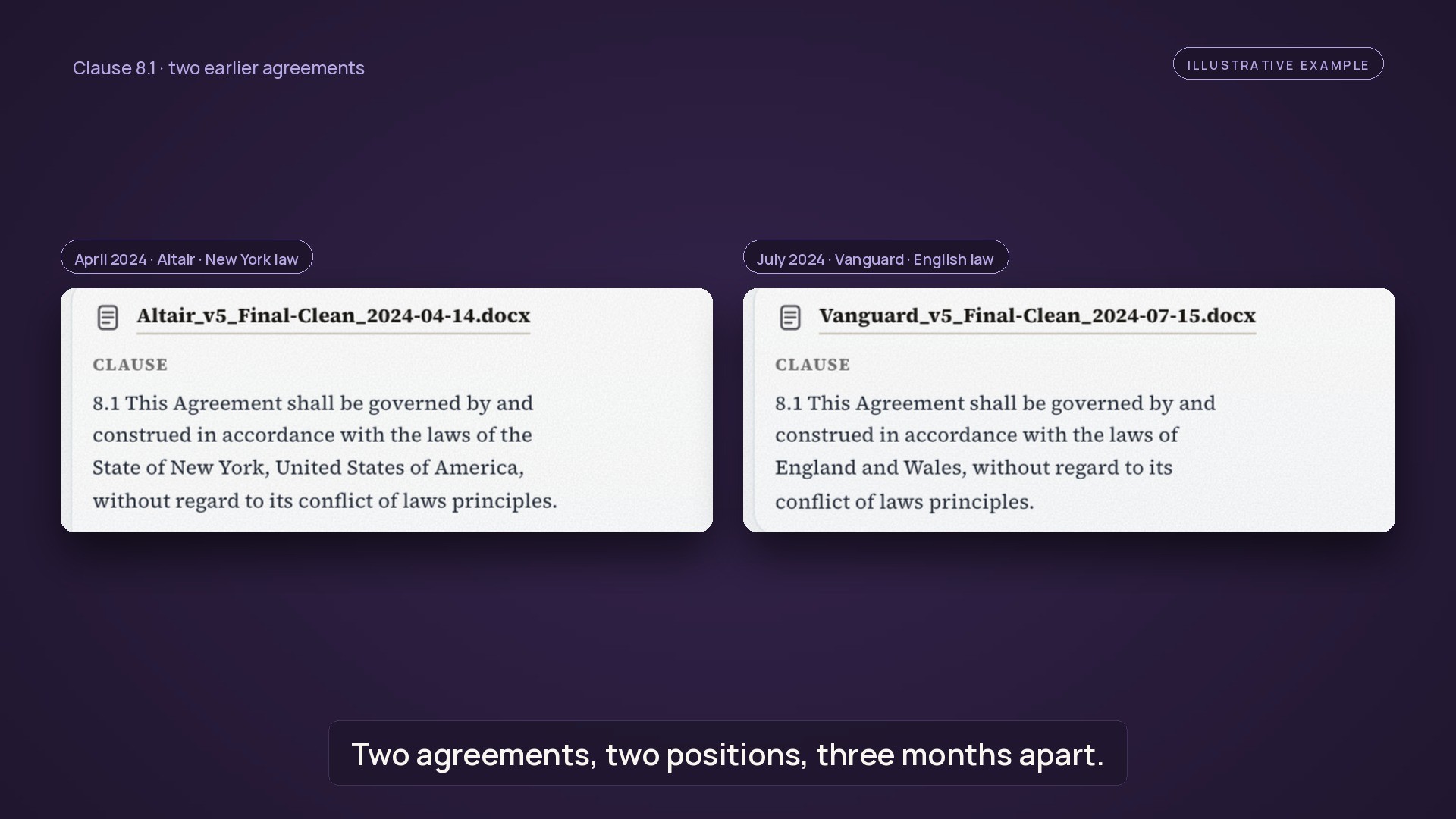
| Label | Date | Entity | Law | Document | Clause 8.1 |
|---|---|---|---|---|---|
| LabelApril 2024 · Altair · New York law | DateApril 2024 | EntityAltair | LawNew York law | DocumentAltair_v5_Final-Clean_2024-04-14.docx | Clause 8.18.1 This Agreement shall be governed by and construed in accordance with the laws of the State of New York, United States of America, without regard to its conflict of laws principles. |
| LabelJuly 2024 · Vanguard · English law | DateJuly 2024 | EntityVanguard | LawEnglish law | DocumentVanguard_v5_Final-Clean_2024-07-15.docx | Clause 8.18.1 This Agreement shall be governed by and construed in accordance with the laws of England and Wales, without regard to its conflict of laws principles. |
Two agreements, two positions, three months apart.
Check the rest of the dispute resolution request
Crestline’s markup changes clause 8.1 from New York to England and Wales. It also changes clause 8.2 from New York court proceedings to ICC arbitration with a London seat. Reading clause 8.1 alone leaves part of the request unchecked.
The April comment mentions ICC arbitration and a New York seat. The July response proposes a London seat. Counsel should read the complete dispute resolution provisions in each source before carrying any part of that earlier position into the new agreement. Similar governing law wording does not establish that the rest of the provisions match.
What to check before responding
- The current instruction. Confirm the preferred governing law and permitted fallbacks for this agreement. If a departure requires approval, identify who can give it.
- The recorded reason. Read the author’s comment beside the clause. Check whether the arrangements named in it still apply to the company and the current deal.
- The source and version. Separate the counterparty’s request from Meridian’s response and the recorded final wording. Check the executed agreement before describing a historical position as agreed.
- The complete request. Compare the governing law and dispute resolution clauses, including the proposed seat. Do not assume a match on clause 8.1 answers the changes in clause 8.2.
- The approval for this response. If the earlier file leaves the authority for a compromise unanswered, seek today’s instruction rather than inferring permission from the old clause.
Use the earlier records to prepare the current response
Lexsophos brings earlier clauses, redlines and recorded comments from retained Word files into review of a new redline, with links to the source documents. In this example, counsel can inspect the April position and July compromise while preparing the response to Crestline.
The useful comparison includes the reason each author recorded and the questions those records leave open. Counsel decides what fits the current agreement under today’s instructions and approval requirements.
at lexsophos.ai. We can walk through the earlier wording, comments and sources using illustrative files. You do not need to send us your contracts.
Film
Watch the film: an earlier concession on a lien clauseIt plays on the home page beside the free 90-day pilot offer.