
When a customer asks a maintenance, repair and overhaul (MRO) provider to delete the lien clause, “we accepted this before” should send counsel to the earlier redline. The company may have agreed to a narrower lien tied to one work order.
An earlier lien redline can show whether the clause was deleted or narrowed. Comments may explain why the wording changed. Check the executed agreement before treating a draft position as what the company finally agreed.
Lexsophos founder Evros Psiloyenis has described searching for a proposed position with less than an hour before a meeting with an attorney. His experience helped shape the product: bring the company’s earlier negotiations into view while counsel is deciding how to answer the current redline.
What an earlier MRO lien redline shows
Take the lien wording in our illustrative MRO demo files. The companies and agreements are fictional. In Vanguard’s version 4, clause 4.1, the original wording describes a general and particular lien over equipment in Meridian’s custody. The redline replaces it with a more limited position.
| Original wording | Replacement wording |
|---|---|
| Original wording“for all sums due and unpaid by Customer under this Agreement or any other agreement between the parties.” | Replacement wording“securing only sums due and unpaid for those Services under the applicable Work Order.” |
The replacement limits the wording to the aircraft or component on which the relevant services were performed and which remains in Meridian’s custody. It refers only to a mechanic’s lien available under the applicable law and excludes a general lien or a lien for amounts owed under other work orders or agreements.
If the new customer requests complete deletion, this earlier redline gives counsel a different position to examine. Describing it simply as “we removed the lien clause” would lose the limits and the wording that remained. Check the executed agreement before treating the displayed version as the final agreed terms.
What a missing comment leaves unanswered
This match says “no comment recorded.” We can inspect the change. We cannot establish from this record why the wording changed.
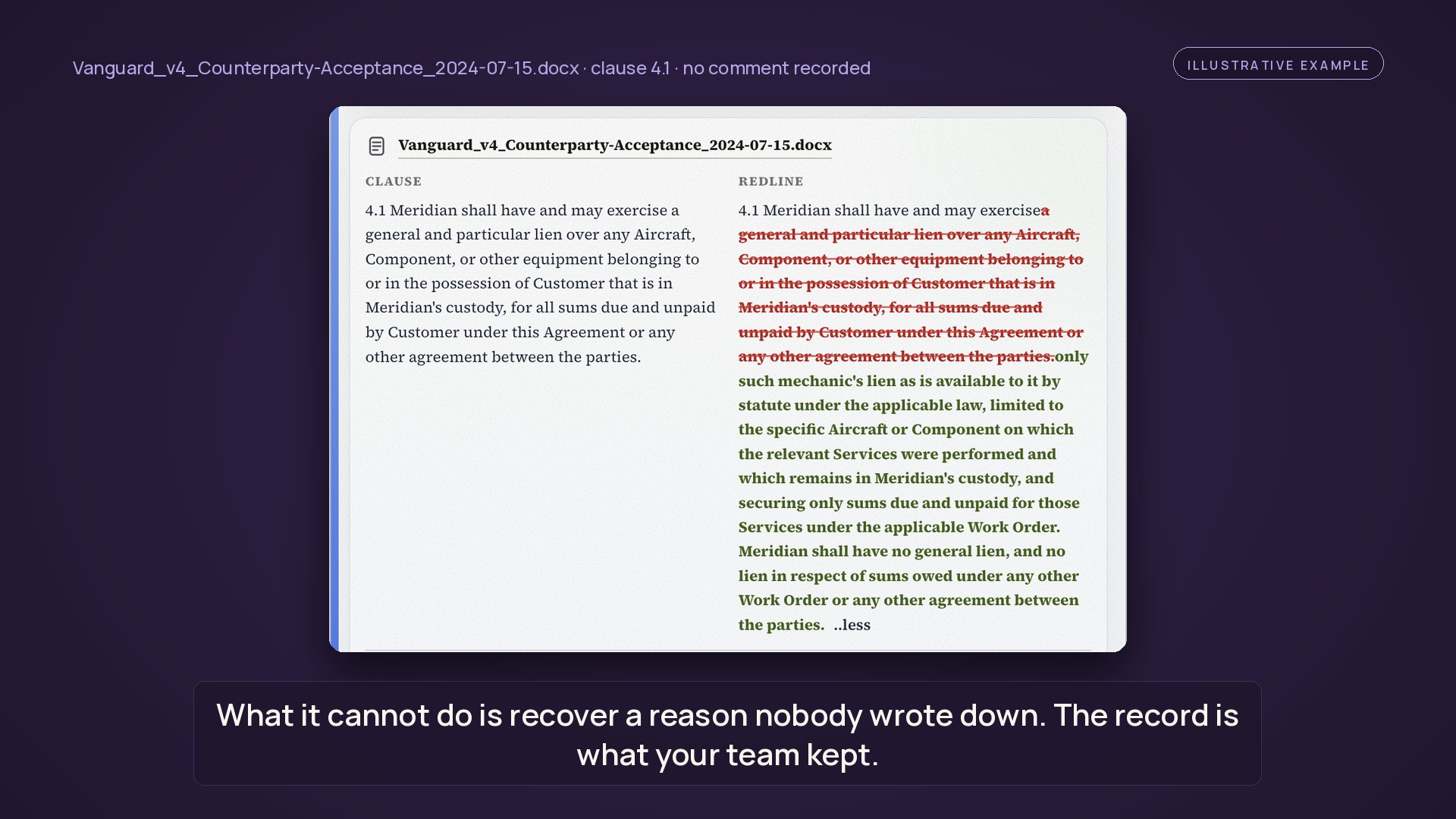
A plausible explanation from AI would still need evidence. The retained files may establish the recorded position without establishing the commercial reasoning behind it. Keep that gap visible so the next negotiator knows what still needs confirming.
Where comments are available, the author matters. A counterparty’s comment explains its request. An internal reply may record a condition, an objection or the team’s reason for proposing a compromise. Read those separately and check the version each addresses before relying on a summary.
Using earlier Word files in a new contract review
For this task, the useful inputs are the retained Word drafts, counterparty redlines, the company’s responses and final versions, with tracked changes and comments intact.
Lexsophos helps aviation legal and contracts teams review new redlines against earlier Word negotiations. It organizes the files by counterparty and agreement type. In the Lexsophos workspace, its Precedent Engine brings earlier wording and recorded comments into view, with the source file available for inspection.
Counsel still has to decide whether that earlier position fits the current payment arrangements, work order and company instructions. A previous compromise gives the reviewer something concrete to assess. It also gives a colleague who was not on the earlier deal a way to examine the work for themselves.
at lexsophos.ai. We can walk through the current request, earlier wording and source file using illustrative documents. You do not need to send us your contracts.